
Navigating Holiday Transitions as a Family: Staying Grounded Before, During and After the Season
The holiday season is in full swing, and holiday transitions can feel like a full-body experience for families. The season arrives in stages — planning, gathering, traveling, unwinding — each with its own blend of joy, pressure, overstimulation, and emotional complexity. Kids feel these transitions too, often more intensely, which means many parents find themselves managing two layers of needs: their child’s nervous system and their own.
This article offers simple ways to stay steady throughout the full arc of the season: before, during, and after the holidays.
1. Before the Holidays: Setting a Foundation for Yourself and Your Family
The lead-up to the holidays can feel like juggling calendars, expectations, financial considerations, school events, and family traditions — all while trying to create something meaningful for your kids. The pressure to “make it magical” can leave parents stretched thin before the season even begins.
A few grounding steps can help create a more intentional start:
Name your family’s intention for the season. This might be connection, slower mornings, saying no to overscheduling, or keeping one cherished ritual.
Check in with your kids. Children often have clear preferences about what matters most to them. Asking early can reduce stress and unnecessary commitments.
Prepare for sensory needs. Kids (and adults) may feel the shift in routine through increased sensitivity, sleep changes, or big feelings.
Family reflection prompt:
What does each person in the household need more of — and less of — this season?
2. During the Holidays: Staying Steady Amid Routines, Gatherings, and Big Emotions
Once the holidays arrive, parents often act as the “regulator” for the family system. Kids feel excitement, dysregulation, overstimulation, and fatigue — sometimes all in one afternoon. Meanwhile, parents are navigating family dynamics, travel, disrupted routines, and their own internal responses.
A few supportive practices can help everyone stay anchored:
Keep one grounding routine in place.
It might be a bedtime ritual, a morning check-in, or a predictable mealtime. Even one steady point can help children feel secure.Honor sensory thresholds by creating micro-breaks.
Step outside if the noise becomes overwhelming, bring comfort items for kids, or limit the length of gatherings when needed.Use flexible boundaries.
You can decline conversations, shorten visits, or take breaks without explanation. Your family’s well-being is reason enough.
Kid + parent reflection prompt:
What helps each of you feel calm, safe, or settled during busy days?
3. After the Holidays: Gentle Re-Entry for the Whole Family
The days after the holidays can feel like emotional whiplash. Kids may return to school tired or dysregulated. Parents may feel relief mixed with exhaustion or a sense of letdown. The transition back to normal life is a big shift for everyone.
Consider easing back in:
Slowly reset routines.
Earlier bedtimes, simple meals, and consistent rhythms can help both kids and parents feel grounded again. Unpacking slowly can make for a softer landing to help regulate everyone.Give space for feelings.
Kids might act out because the transition is hard. Parents might notice their own emotions surfacing once the busy days pass. This is normal.Notice what worked this year.
Small insights now can make next year smoother.
Family reflection prompt:
What did we learn from this holiday season about what supports us — and what overwhelms us?
Closing: Meeting the Season With Clarity and Care
Holiday transitions don’t require perfection. They ask for presence, intention, and gentle awareness of what your family system needs at each stage. When you honor your child’s needs and your own, the season becomes more spacious and supportive — not something to “get through,” but something you can move through with steadiness.
Wishing you and your family moments of calm, connection, and clarity as you navigate the full rhythm of the holidays.
2025 Practice Updates
We are already through the first month of 2025, and I have been coming up for air after having a lovely restful time off during the holiday season. January is usually a busy time for welcoming new clients to my practice, preparing for tax season, and setting professional intentions for the year ahead. In this vein, I also want to acknowledge how much our country and world have changed since last year. Many clients are coming to therapy with many anxieties about their sense of community safety and belonging. I hope to provide support and services to meet you in those spaces of anxiety and offer ways to keep you healthy during these uncertain times.
This being said, here are a few pre-existing offerings and new updates in my practice in 2025:
Somatic processing: I have attended many somatic trainings and find that when we have too much coming at us, we often get emotions and stress stuck in the body. Therapy sessions can help us keep our bodies free from emotional and stressful blockages. Many suggestions involve finding micro-movements that feel good to the body, help to release stress, and activate more of our parasympathetic nervous system (rest and digest).
Cannabis education: Last year, I completed a course on becoming a Cannabis Educator. While I am not able to give direct recommendations on the use of cannabis, I can talk through what and how cannabis can work as a healing medicine, a fantastic endocannabinoid system regulator, and how to manage symptoms of tolerance and titrating with CBD products. CBD is a non-psychoactive substance found in hemp and is legal for over-the-counter use. I highly advocate experimenting with CBD products to help with anxiety-related symptoms.
Florida clients with Blue Cross Blue Shield (Florida Blue) insurance: I am now an in-network provider for Florida Blue and am accepting new clients. If you have out-of-state Blue Cross plans, I offer to provide superbills for your therapy fees to see if you can get in-network reimbursement. Please remember that I cannot provide superbills if you live outside my licensed states (Illinois, Georgia, Florida).
Counseling Compact to expand provider access across state lines: The counseling field has initiated the same type of national licensing compacts that psychologists and other licensed providers already have. The national compact allows licensed counselors to become licensed in multiple states more easily. They hope the compact will be open for applications starting later this year. Upon learning more about the procedures, I hope to expand my access to Missouri, Wisconsin, Colorado, and other states.
Every year, I set learning goals aligned with my values as a psychotherapist and healer. This year, I am taking more courses around neurodiversity, obtaining more training specifically for women with ADHD, and taking a course on using nutrition supplementation to balance neurotransmitter function. I'm excited to share more about my learning and offerings in the coming months! In the meantime, if you are interested in working with me, my application is here. Take good care of yourself!
Embracing Neurodiversity: A panel discussion at Gulf Coast State College
Last month during Autism awareness month, I had a privilege of being a part of a panel discussion at Gulf Coast State College on Neurodiversity. While most school years are coming to a close, we had a robust conversation among two neurodiverse students and two professionals on a wide variety of topics in neurodiversity. Since our topics share so much relevance to neurodiverse students, clients and people in the world, I thought I would share a few of the questions and answers we discussed in the panel.
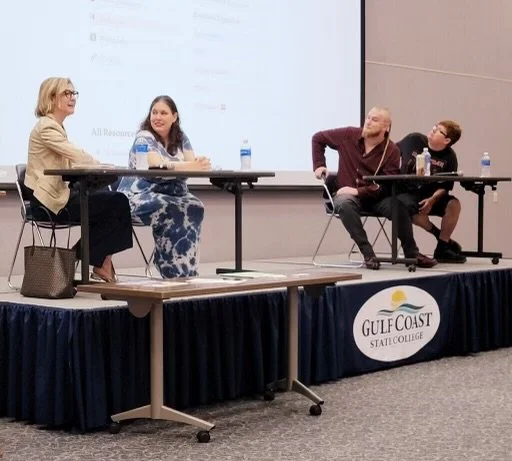
Our Neurodiversity panel at Gulf Coast State College: yours truly, Crystal Grey-Hewett from FSU CARD autism program, along with Darian and William, our neurodiverse student representatives.
In what ways do you believe neurodiversity enriches academic, professional, or creative communities? Neurodiversity can enrich many spaces with innately different vantage points in which to approach a question, problem, outlook, behavior, or viewpoint. All spaces, when approached with curiosity and openness, can benefit from a different viewpoint or way of doing things.
Analogy of using hyper focus: For many ND people, they have the ability to hyper focus on areas of interest. This can look like: lots of research, collecting everything about the topic, making art about the topic, sending lots of emails or communicating for long periods about the topic. In this way, if you give an ND person something to work on that speaks to already expressed interest, you have a gem of a student, employee, or colleague to help assist in any joint effort.
How can we better accommodate neurodivergent students, particularly those with ADHD and autism? Can students where sunglasses, hats, earplugs/headphones other wearable accommodations? Can lighting be adjusted if requested? Can students write down their questions or responses before being called upon suddenly in class? What are teachers communication expectations regarding email response time, etc?
How can we as an institution and individuals foster an environment that not only accommodates but celebrates neurodiverse people? Allow for the unexpected and unusual. Let yourself be surprised by differing viewpoints and communication styles. Allow a person to talk with you about their special interest, then trade. Make time for special help or 1:1 time: learning lab, tutors, but also instructors. Allow what you used to think was weird or “out of bounds.”
What strategies would you recommend to neurodivergent students to be proactive in their self-care and academic success? First, self-accommodation is self care. Second, look to your previous academic year as a guide for what may work. When in doubt, look to the big five: Sleep, nutrition, time management (schedule and downtime), sensory, and support.
How can students build a support team on campus? What roles can peers, faculty, and mental health professionals play in this team? Utilize support services for learning (tutors), accommodations (disability services), class (office hours), finding a ND buddy on campus, counseling, advising, and mental health care if needed.
What message or advice would you give to neurodivergent individuals about recognizing and leveraging their unique strengths? Your difference is your strength. Find people who see your difference and celebrate it, are curious about it, and want to know more. Many high functioning ND people feel as though their lived experiences of the world is different than other people. So letting your story be seen, be heard, and be expressed in a space where you are safe and supported!
If you are reading this, and are interested in working with me, feel free to fill out my application here or email me. I look forward to helping you in your neurodiverse journey!
Gender-Affirming & Neurodiverse Mental Healthcare: an update
Last year, I wrote about inclusivity during Pride month, and also came out! This year, the timing of this post coincides with the national conversation around gender-affirming care. This access has been threatened for many people, including those in my state of Florida.
Since I identify as a neurodiverse queer person who is still learning how to present as an inclusive psychotherapist, I wanted to take some time to share a bit about how I am working on providing ongoing affirming care for my diverse clients.
First, a few disclaimers. I am a Caucasian female (she/they) who innately has privilege based on these two facts. I do not experience blatant discrimination based on my gender identification, sexual orientation, or race. Due to my economic privilege, I have found independent practitioners who provide gender and neurodiverse healthcare.
During our intake process, I will ask if you prefer any electronic forms to communicate any needs related to your mental health care. I usually gather this information in a conversational style so that you can disclose or withhold any information at your pace. However, some neurodiverse people prefer to communicate in writing, and you will have this option throughout our treatment.
In this ongoing relationship, I will be asking for any neurodiverse, cultural, gender, sexuality, or other considerations you would want me to know. Again, this information will also be available in written form. As we progress, I approach all therapeutic relationships with a sense of curiosity and a beginner’s mind. You are ultimately the expert on yourself, and if I don’t understand something, my neurodiverse brain will seek to understand by remaining open to you and your lived experience.
As your advocate, I have worked with clients with comorbid physical health issues that are often chronic and ongoing. I work hard to help my clients find local doctors, dentists, and bodyworkers who are considerate of chronic conditions. In this search, I am also looking for healthcare providers who listen and consider my clients neurodiverse and gender orientations as part of their ongoing care.
Despite my efforts to educate myself and remain curious and compassionate, I still make mistakes. Moving through the world as a queer or trans person often feels dangerous. I understand that paranoia is a natural byproduct of hate and discrimination. I also know that I may miss things, despite working on my blind spots and my innate privilege. I hope we work together with ongoing collaboration, curiosity, and grace.
Being proud of who we are is an innate right we all have as human beings. I am proud of my neurodiverse brain, my androgynous orientation to sexuality and gender, and my growing capacity for love in all forms. If you are interested in working with me, please fill out my application here or email me here.
Hiring a Neurodiverse Therapist
Earlier this year, I underwent psychological testing and discovered I am on the autism spectrum. This realization has led to a lot of reflection around how I show up as a human and a psychotherapist. I wanted to share a few of these realizations, for those of you who may be looking for a trauma-informed, neurodiverse psychotherapist.
1 . What is neurodiversity? Judy Singer, a sociologist who has autism, started using the term "neurodiversity" in the late 1990s. It refers to the concept that certain developmental disorders are normal variations in the brain. And people who have these features also have certain strengths. Devon Price, the author of Unmasking Autism, creates a wider umbrella for neurodiversity to include many different types of mental health diagnosis that can create brain variations such as: ADHD, OCD, PTSD, and bipolar disorder. My version of neurodiversity, which presents mostly as Aspergers (the now-obsolete term for autism without intellectual disability), means I have deficits in how I socialize, verbalize, and connect with other humans.
2. How can I benefit? One of the hallmarks of autism in the brain is the connectivity differences. Which is to say:
“certain brain regions show high interconnectivity in autistics and comparatively reduced connectivity in neurotypicals, while other brain regions show lower connectivity in autistics and comparatively elevated connectivity in neurotypicals.” (Embrace Autism, connectivity)
Having a neurodiverse psychotherapist can benefit a person who is wanting someone to look at them, their problems or symptoms, in a different way. Having a neural adaptation that views the world through a difference lens can provide perspectives to help assist clients in a change in mindset and even behavior change.
3. Feedback can be tailored. Another hallmark of being on the autism spectrum is my ability to deliver honest feedback. The common problem with my unfiltered version of feedback, is it can come off as too blunt, too direct, or even hurtful. I have learned over the years, that if I have an insight or feedback for clients, to ask first if they want the feedback. As a client, I may even ask if you want feedback presented in a direct fashion, or in a more indirect way. As a rule of thumb, I am able to assess and provide this feedback quickly upon meeting most clients.
4. Relatability as a form of connection. The final realization I wanted to share in hiring a neurodiverse therapist, is that being able to relate is a part of how I connect. In reading various books and articles on autism, one of the ways I learn to connect is by finding common ground. Very often, this could be perceived as making someone else’s topic about me, or disclosing too much about myself as a therapist. If you are noticing that I am relating to you in a session, within appropriate boundaries, it is a way to let you know you are not alone. My goal in relating is to provide connection that is inclusive, and I continue to work on my relatability with all my clients.
If you are reading this, and are also neurodiverse, I would love to hear from you! The more our world is able to embrace all forms of neurodiversity, the more we are all able to be ourselves. I can provide general guidance and feedback for anyone who is looking for a more supportive experience, whether as a psychotherapy client, professional, or human in this world. Please email me or apply to become a client. I look forward to hearing from you!
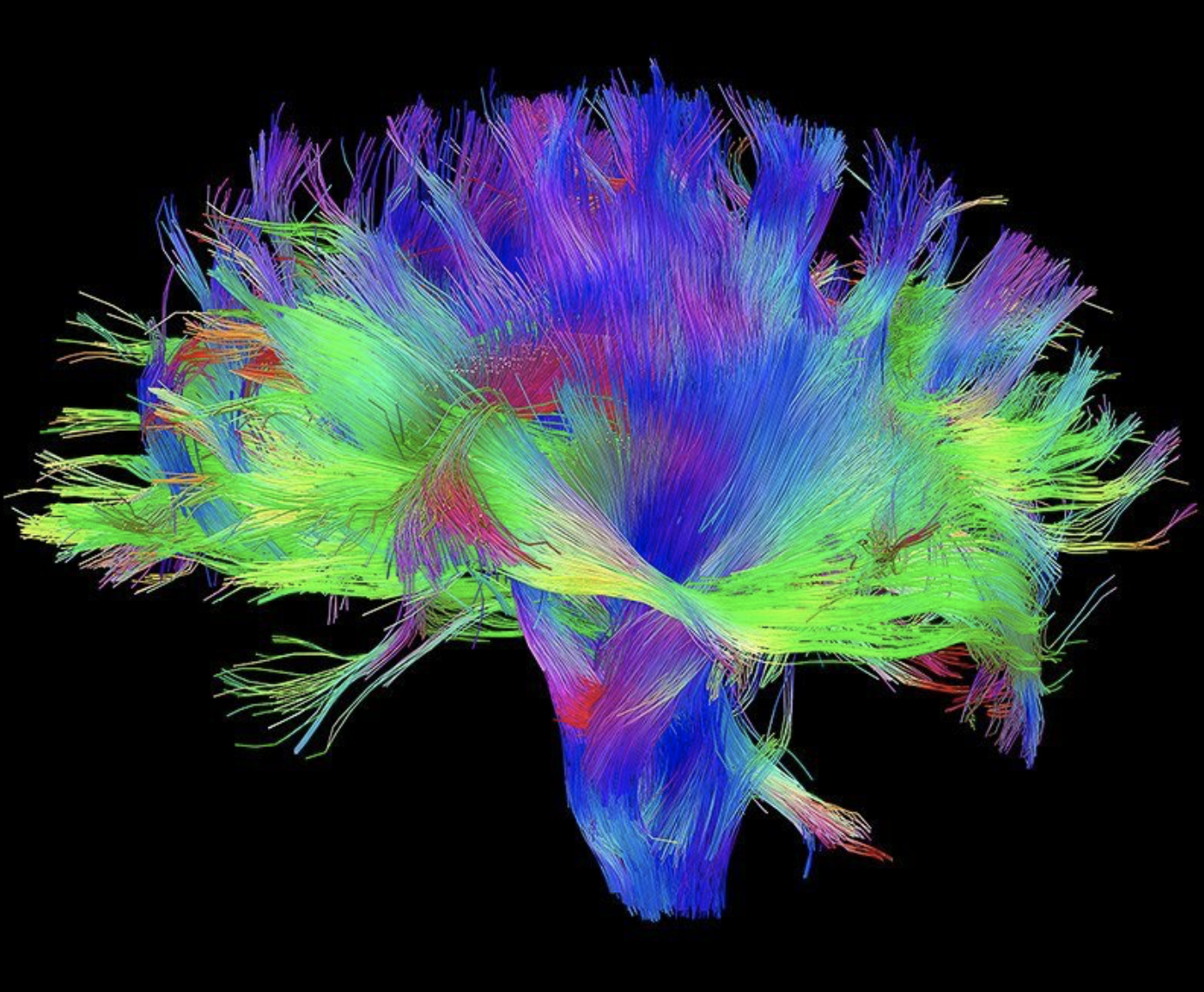
Diffusion MRI of the human brain. (Image source: Human Connectome Project)